CS 375 Review
Tuneable Machines Playing Optimization Games
Seeing but Not Perceiving
Go and tell this people:

“‘Be ever hearing, but never understanding;
    be ever seeing, but never perceiving.’
Make the heart of this people calloused;
    make their ears dull
    and close their eyes.
Otherwise they might see with their eyes,
    hear with their ears,
    understand with their hearts,
and turn and be healed.”(Isaiah 6:9-10, NIV)
Tuneable Machines Playing Optimization Games
The Big Picture
We studied AI by building one from scratch: a neural network classifier.
Tuneable Machines (TM)
A computer made of tweakable math:
- Arrays of numbers flow through layers
- Each layer: multiply, add, squish
- Billions of knobs to adjust
Key deep-dive: the MLP classifier
Extension: the CNN we built for image classification = MLP but with convolutional layers in the feature extractor body.
Optimization Games (OG)
A game that defines what “better” means:
- A world where the agent can act and get feedback (e.g., dataset of labeled examples)
- A score function for quantifying success (e.g., loss)
- A strategy for improving (e.g., gradient descent)
Key deep-dive: supervised learning: mimicking a given set of (input, correct answer) pairs
Part 1: Tuneable Machines
The MLP Classifier: Our Core Example
The simplest “deep” network — and the building block of everything else.
Input → [Linear] → [ReLU] → [Linear] → [Softmax] → Probabilities → Loss
 (784)    784→100            100→10
Every modern neural network is a variation on this theme: linear transformations, nonlinearities, and a loss function.
TM-LinearLayers: The Workhorse Operation
A linear layer computes y = x @ W + b:
- Matrix multiply (
@): each output is a weighted combination of all inputs - Bias (
+ b): shifts the output - “Fully connected”: every input connects to every output
Shape rule: (batch, n_in) @ (n_in, n_out) → (batch, n_out)
Hands-on: u03n1 (manual linear regression), u04n3 (PyTorch logistic regression)
TM-ActivationFunctions: Why Nonlinearity Matters
ReLU: y = max(0, x) — chop off the negative part.
Without it, stacking linear layers just gives another linear layer. With it, the network can learn conditional behavior: “activate this feature only when the input has this property.”
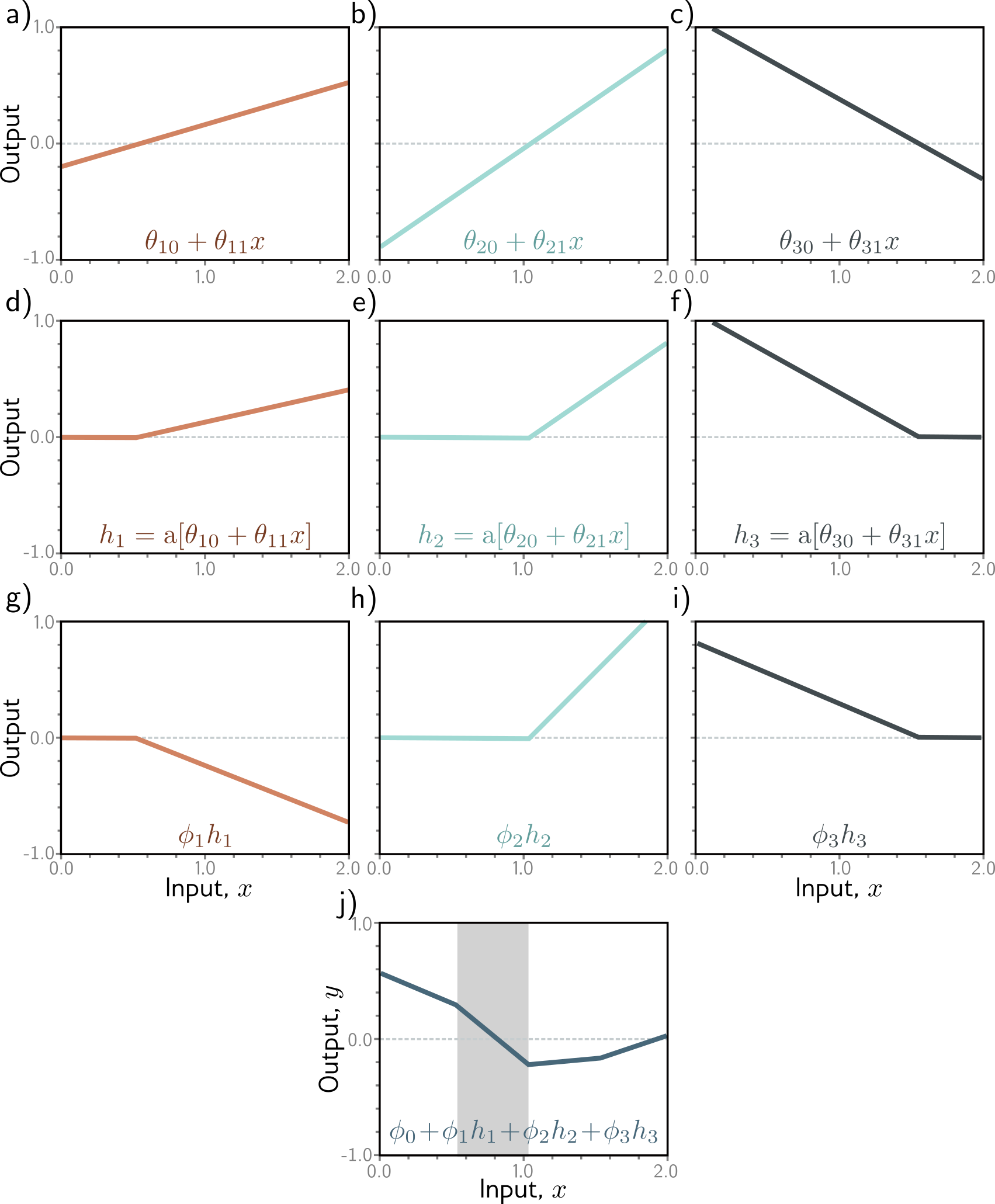
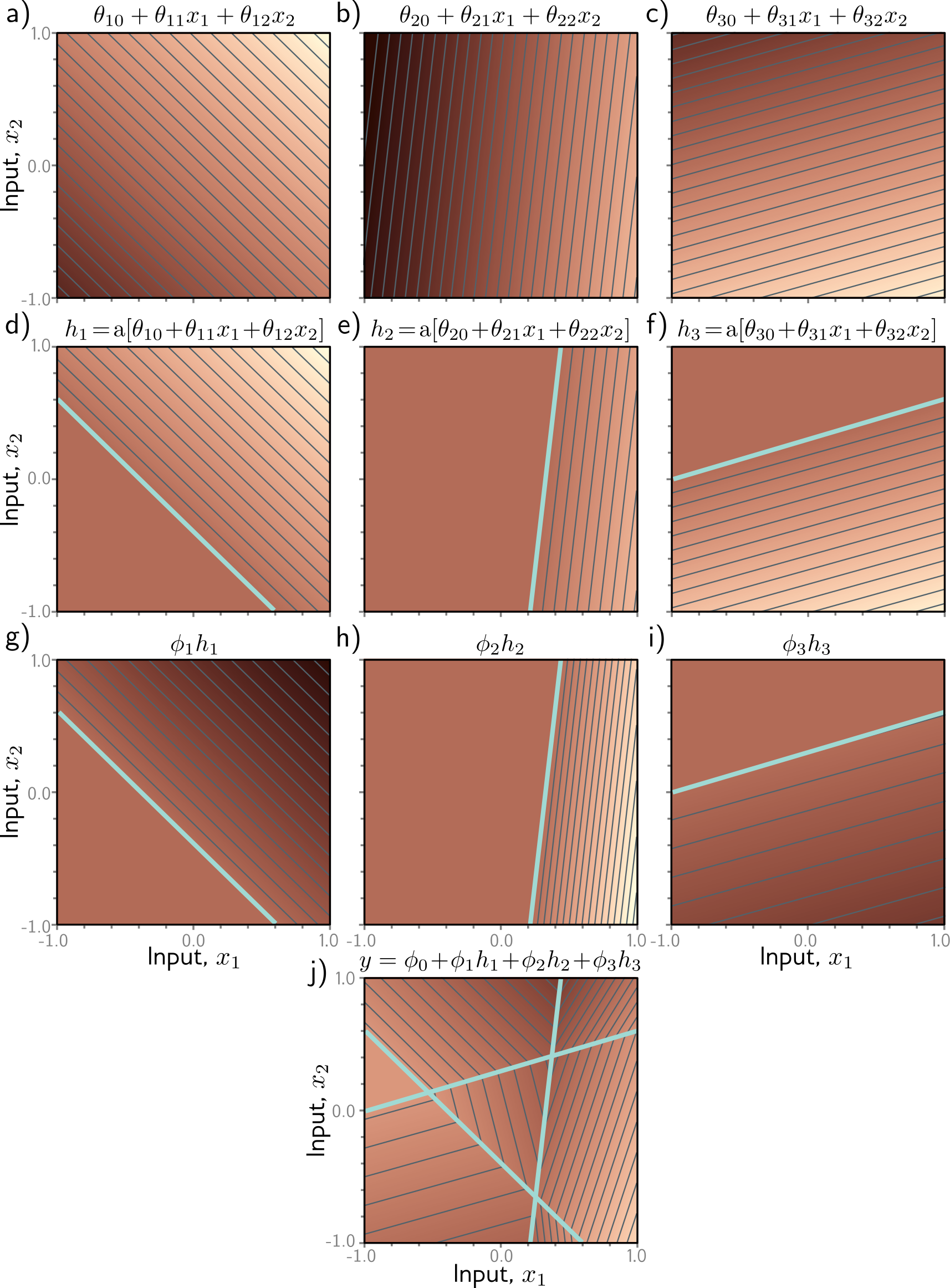
In practice, variants like GELU and SiLU/Swish avoid ReLU’s hard zero, giving smoother gradients. We use ReLU for simplicity; the intuition transfers.
Hands-on: u05n00 (ReLU interactive)
TM-Softmax: Scores to Probabilities
Three steps: exponentiate → sum → divide.
logits:  [2.0,  1.0,  0.1]
exp:     [7.39, 2.72, 1.11]    (make positive)
softmax: [0.66, 0.24, 0.10] (normalize to sum to 1)- Largest logit (or “score”) → largest probability
- Adding a constant to all logits doesn’t change the output (but multiplying does!)
- Part of the architecture (we’d still use it even if the inputs happen to be valid probabilities)
- Paired with cross-entropy loss for classification
Hands-on: u04n2 (softmax), u05s2 (softmax deep-dive)
TM-MLPParts: The Full Forward Pass
Given an image of a digit (flattened to a vector), compute the network’s prediction and loss:
- Input vector (784,)
- Layer 1:
z1 = x @ W1 + b1→ shape (100,) — these are pre-activations - ReLU:
a1 = max(0, z1)→ shape (100,) — these are activations - Layer 2:
z2 = a1 @ W2 + b2→ shape (10,) — these are logits - Softmax:
probs = softmax(z2)→ shape (10,) — these are probabilities - Loss:
loss = -log(probs[correct_class])— this is cross-entropy
We show one hidden layer; real networks stack many (repeating steps 2–3). The pattern is always: linear → nonlinearity → linear → nonlinearity → … → output.
Key vocabulary: weights, biases, activations, logits, probabilities, loss
Hands-on: u06n1 (trace MNIST classifier step by step)
TM-DotProduct: The Atomic Operation
The dot product of two vectors: multiply pairs, then sum.
a = [1, 0, 3]
b = [2, 5, 1]
a · b = 1×2 + 0×5 + 3×1 = 5
Three ways to think about it:
- Computation: it’s what matrix multiply does, element by element
- Similarity: high dot product = vectors point in similar directions
- Geometry: zero dot product = vectors are perpendicular (unrelated)
Caveat: dot product conflates direction and magnitude — a huge vector gets a high dot product with everything. Cosine similarity fixes this by normalizing to unit vectors first, isolating direction.
Hands-on: u04n1 (manual multi-output linear regression uses @ throughout)
TM-TensorOps: Shapes as the Type System
Shapes tell you what the data means:
(batch_size, n_features)— a batch of feature vectors(n_features, n_classes)— a weight matrix(batch_size, n_classes)— predictions for a batch
The matmul shape rule: (m, n) @ (n, p) → (m, p) — inner dims must match.
Most bugs in neural network code are shape mismatches. Trace shapes through the network to debug.
Hands-on: u02n1 (PyTorch basics), u04n1 (multi-output regression)
TM-DataFlow: Drawing the Diagram
          Parameters        Activations
          ──────────        ───────────
Input ──→ W1:(784,100) ──→ z1:(B,100)
(B,784)   b1:(100,)         │
                            ▼ ReLU
                           a1:(B,100)
                            │
          W2:(100,10)  ──→ z2:(B,10)    ← logits
          b2:(10,)          │
                            ▼ Softmax
                            probs:(B,10)    ← probabilities
                            │
y_true:(B,) ──→ loss: scalar ← cross-entropy- Parameters (W, b): learned, persist across batches.
- Activations (z, a, probs): computed fresh each forward pass.
Hands-on: u06n1 (trace MNIST), Quiz 2
How It Learns: Autograd
TM-Autograd: You write the forward pass; PyTorch computes the backward pass.
# Forward pass (you write this)
y_pred = model(x)
loss = F.cross_entropy(y_pred, y_true)

# Backward pass (PyTorch does this)
loss.backward()  # computes gradients of loss w.r.t. all parameters

# The gradient of each parameter tells you:
# "which direction would INCREASE the loss?"
# So we go the opposite direction.
optimizer.step() # updates parameters to DECREASE lossrequires_grad=Trueon parameters tells PyTorch to track operationsloss.backward()walks the computation graph in reverse (chain rule)- Gradients accumulate, so
optimizer.zero_grad()clears them each step
Hands-on: u06n2 (compute gradients in PyTorch)
TM-Implement-TrainingLoop: The 5-Step Loop
for epoch in range(n_epochs):
    for x_batch, y_batch in dataloader:
        y_pred = model(x_batch)         # 1. Forward pass
        loss = loss_fn(y_pred, y_batch) # 2. Compute loss
        optimizer.zero_grad()           # 3. Backward pass
        loss.backward()                 #
        optimizer.step()                # 4. Update parameters
    # 5. Evaluate on validation set
    val_loss = 0.
    for x_val, y_val in val_loader:
        with torch.no_grad():
          y_val_pred = model(x_val)
          val_loss += loss_fn(y_val_pred, y_val).item()
This is the same loop for every neural network — from MNIST to GPT.
Hands-on: u06n1 (MNIST in PyTorch), u06s2 (MNIST with augmentation)
OG-Theory-SGD: The Learning Mechanism
(Bridges both pillars: this is what connects the machine to the game.)
Gradient = direction of steepest increase of the loss.
Gradient descent = move parameters in the opposite direction.
- Learning rate: step size. Too big → overshoot. Too small → too slow.
- Stochastic (mini-batch): use a subset of data each step.
- Faster than full-batch; noise helps escape bad local minima.
Parameters ──[subtract lr × gradient]──→ Updated ParametersBeyond vanilla SGD:
- Momentum: accumulate past gradients to smooth updates and push through flat regions
- Adam: adapt the learning rate per parameter — no single learning rate fits all layers
Most practitioners default to Adam.
Hands-on: u03n1 (manual gradient descent for linear regression)
Beyond the MLP: Embeddings
TM-Embeddings: Neural networks represent data as vectors where geometric relationships encode meaning.
- Similar items → similar vectors (high dot product, small distance)
- Clusters in 2D visualizations show learned categories
- Learned embeddings capture structure that hand-crafted features miss
Examples: word embeddings (king - man + woman ≈ queen), image embeddings (CNNs), user/movie embeddings (recommender systems)
Hands-on: u07n1 (image embeddings), u09n1 (word embeddings - in 376)
Beyond the MLP: Representation Learning
TM-RepresentationLearning: Hidden layers transform the data to make the task easier.
- Early layers: extract low-level features (edges, textures)
- Later layers: combine into high-level concepts (faces, objects)
- Final layer: a simple linear classifier on these learned features
This is why transfer learning works: the features learned for one task (ImageNet classification) are useful for many other tasks.
Hands-on: u05n1 (image classifier with pretrained feature extractor)
Beyond the MLP: Convolutions
Convolution: Specialized layers for spatial data (images).
Two key improvements over fully-connected layers:
- Parameter sharing: same small filter applied at every position
- Translation invariance: recognizes a feature regardless of location
A CNN = convolution layers + pooling + fully-connected layers at the end.
CNN Explainer interactive visualization: poloclub.github.io/cnn-explainer/
Part 2: Optimization Games
Supervised Learning: Our Core Game
The game has simple rules:
- Given: a bag of (input, correct answer) pairs
- Goal: learn to predict correct answers for new inputs
- Score: how well do your predictions match? (loss function)
The machine learns by mimicry — imitating the training data.
OG-ProblemFraming-Supervised: Setting Up the Game
To frame a supervised learning problem:
- Inputs: what does the model see? (features, images, text, …)
- Targets: what should it predict? (numbers → regression, categories → classification)
- Loss function: typically MSE for regression, cross-entropy for classification
- Success metric: what do stakeholders actually care about?
Example: “Detect pneumonia from chest X-rays” → inputs = image, target = {pneumonia, healthy}, loss = cross-entropy, metric = sensitivity (TPR) — because missing a case is worse than a false alarm. Note: the loss (cross-entropy) is what the model optimizes; the metric (sensitivity) is what stakeholders care about. They’re often different!
Hands-on: u02n2 (sklearn regression), u03n2 (sklearn classification)
OG-LossFunctions: Keeping Score
MSE (regression): average of squared errors. Penalizes big mistakes heavily.
\[\text{MSE} = \frac{1}{n}\sum_i (y_i - \hat{y}_i)^2\]
Cross-entropy (classification): average surprise at the correct answer.
\[\text{CE} = -\frac{1}{n}\sum_i \log p(\text{correct class}_i)\]
Why not accuracy as a loss? Its gradient is almost always zero — the model can’t learn from it.
Hands-on: u03n1 (MSE by hand), u04n2 (cross-entropy), u04n3 (PyTorch classification)
Playing the Game Well: Evaluation
OG-Eval-Experiment: Why held-out data matters.
- Training set: the model learns from this
- Validation set: we tune hyperparameters using this
- Test set: final, unbiased evaluation (touch it once!)
Learning curves (loss vs. epoch) tell the story of training:
- Loss goes down → learning is working
- Val loss goes up while train loss goes down → overfitting
- Both stay high → underfitting
Hands-on: every lab from u04 onward includes train/val curves
OG-Implement-Validate: Validation Discipline
Split before you fit. Always.
# 1. Split data FIRST
X_train, X_val, y_train, y_val = train_test_split(X, y)

# 2. Train on training set only
model.fit(X_train, y_train)

# 3. Evaluate on validation set
val_score = model.score(X_val, y_val)

# 4. Spot-check predictions on specific examples
model.predict(X_val[:5])  # Do these make sense?
Validation performance is a better estimate of real-world performance than training performance.
OG-Generalization: When Models Fail
Overfitting: model memorizes training data but doesn’t generalize.
- Symptom: train loss low, val loss high (or rising)
- Interventions: more data, augmentation, regularization (dropout, weight decay)
Underfitting: model can’t even fit the training data.
- Symptom: both train and val loss remain high
- Interventions: bigger model, more training, better features
Bias-variance tradeoff:
- Bias = error from wrong assumptions. A model that’s too simple consistently misses the pattern, no matter what training data you give it. (Think: fitting a line to a curve.)
- Variance = error from sensitivity to the specific training set. A model that’s too complex fits the noise in this particular sample and gives wildly different predictions on a different sample.
- The sweet spot balances both — complex enough to capture the pattern, simple enough not to memorize the noise.
Interactive: Bias-Variance · Double Descent (MLU Explain)
Hands-on: u06s1 (bias-variance), u06s2 (augmentation and regularization)
OG-DataDistribution: Training ≠ Deployment
The model can only learn what’s in the training data.
- Selection bias: training data missing certain groups or conditions
- Domain shift: deployment conditions differ from training (time, geography, demographics)
- Data augmentation: artificially expand the distribution (flips, crops, noise)
A model that’s 99% accurate on ImageNet may fail on photos from a different camera, lighting, or culture.
Hands-on: u06s2 (augmentation), HW1 (real-world image classification)
Beyond Supervised: Other Games
OG-ProblemFraming-Paradigms: Not all learning is mimicry.
| Paradigm | Learning signal | Example | What it can learn |
|---|---|---|---|
| Supervised | Labeled examples | Image classification | To imitate the labels |
| Self-supervised | Predict hidden parts of data | GPT (predict next token) | Patterns in data |
| Reinforcement | Rewards from interaction | Game playing, robotics | Strategies beyond imitation |
- Supervised learning is limited to imitating the training data.
- RL can explore and discover strategies no human demonstrated. It builds its own training data by trying things and seeing what works.
Beyond Supervised: Pretrained Models
OG-Pretrained: Standing on the shoulders of giants.
The body + head pattern:
[Pretrained feature extractor] → [Your task-specific classifier]
(frozen or fine-tuned) (trained from scratch)- Benefits: leverages knowledge from massive datasets; works with small task-specific data
- Risks: inherited biases, domain mismatch, licensing
- Fine-tuning vs. feature extraction: update the body or freeze it?
Hands-on: u05n1 (pretrained CNN for image classification), HW1
LLM APIs: Using sequence models
Key abstraction: the conversation — a structured “document” with system instructions, user messages, assistant responses, “tool” calls/responses, reasoning traces
API: you ask for the next message given the conversation so far (no training)
Stateless: Each conversation is independent — the model itself doesn’t remember past conversations (but system can prepend them to future conversations)
Agent extension: the model can output requests to run code (e.g., search, calculate, edit file); the system runs the code and includes the output in the conversation
When appropriate: text tasks, prototyping, when training data is scarce
When not: latency-critical, cost-sensitive, tasks requiring precise numeric output
Part 3: The Bigger Picture
Overall: Context and Implications
We’ve studied the mechanics. Now: what does it mean?
Overall-Impact: Who Is Affected?
When deploying an AI system, ask:
- Stakeholders: Who benefits? Who might be harmed? (Often different groups.)
- Distribution: Does the training data represent the deployment population?
- Feedback loops: Will the system’s outputs change future inputs?
- Resume screening → fewer diverse hires → less diverse training data → …
- News recommendations → users see only confirming views → more extreme content → …
- Recourse: What happens when the system is wrong?
(based on Shneiderman, Human-Centered AI; see also Gender Shades, COMPAS; ACM FAccT
Overall-Faith: AI in God’s Story
Christian concepts that inform how we think about AI:
- Imago Dei: humans are made in God’s image — AI capabilities don’t diminish human dignity
- Shalom: technology should contribute to wholeness, not just efficiency
- Stewardship: we’re responsible for how we build and deploy these tools
- Imitation: Paul urged Christians to imitate Christ — what does it mean when machines imitate us? Act like you want the machine to imitate you when it counsels others.
“We shape our tools, and thereafter our tools shape us.” — Churchill/McLuhan
Connections
Looking Forward to CS 376
Building state-of-the-art AI systems out of the building blocks we’ve studied:
- Flexible data structures: architectures for text, images, sound, etc. (e.g., attention, transformers)
- Generative models: producing images, text, audio
- Advanced use of LLMs: prompting, RAG, tool use, agents
- Reinforcement learning: learning from exploration and experience
- The training pipeline: how models like DeepSeek are actually trained
Optimizing the Right Thing
- Goodhart’s Law: “When a measure becomes a target, it ceases to be a good measure.”
- Example: optimizing for clicks → clickbait; optimizing for accuracy → gaming the test set; optimizing for engagement → social media addiction
- We’ve built amazing machines for optimizing numbers at huge scale.
- Is it good to optimize that number?
- AI will eventually “game” even the best-intentioned measures.
- Need people who can reflect on how numbers do/don’t reflect values.
Human Futures
- Everything that:
- Has a clear metric of success
- Can be done sitting alone at a computer (including operating a robot)
- Is repeatable
- will be automated sooner or later. So you should emphasize:
- Situations where “good” is hard to define
- Incarnate in the world, in community
- Being vulnerable and courageous
Remind you of Calvin’s mission?
We are not machines. That’s good. Don’t forget it.
Reflection
What concept from this course has changed how you think about AI?
What questions do you still have?
Commission
Whatever you do, work at it with all your heart, as working for the Lord, not for human masters, since you know that you will receive an inheritance from the Lord as a reward. It is the Lord Christ you are serving. — Colossians 3:23-24
Treat people as God’s image-bearers, not like machines.
Work with AI systems, not as magic but as computational tools.
Keep learning. Keep thinking. Use the natural intelligence God gave you, together with all the artificial intelligence that God enabled, to love God and neighbor.