Learning Machines
Ken Arnold
Intro Activity: Teachable Machine
Team up with one or two other people near you.
- Go to https://teachablemachine.withgoogle.com/train/image
- Train a simple classifier using your webcam. Don’t worry about making it super accurate. Ideas: which hand are you holding up? happy or sad face? looking left or right? two colors?
- Discuss with your partners how you might quantify the performance of your classifier. Evaluate your classifier according to your plan.
- On a nearby whiteboard, write (1) your classifier’s task and (2) your evaluation results.
Discuss with your partners:
- What were the inputs and outputs of this system? Where did its training data come from? How did it know what it should learn?
- What did the evaluation number tell you about the system? What did it not tell you?
- True or False: the model continuously learned from its mistakes.
- Is “Teachable Machine” intelligent?
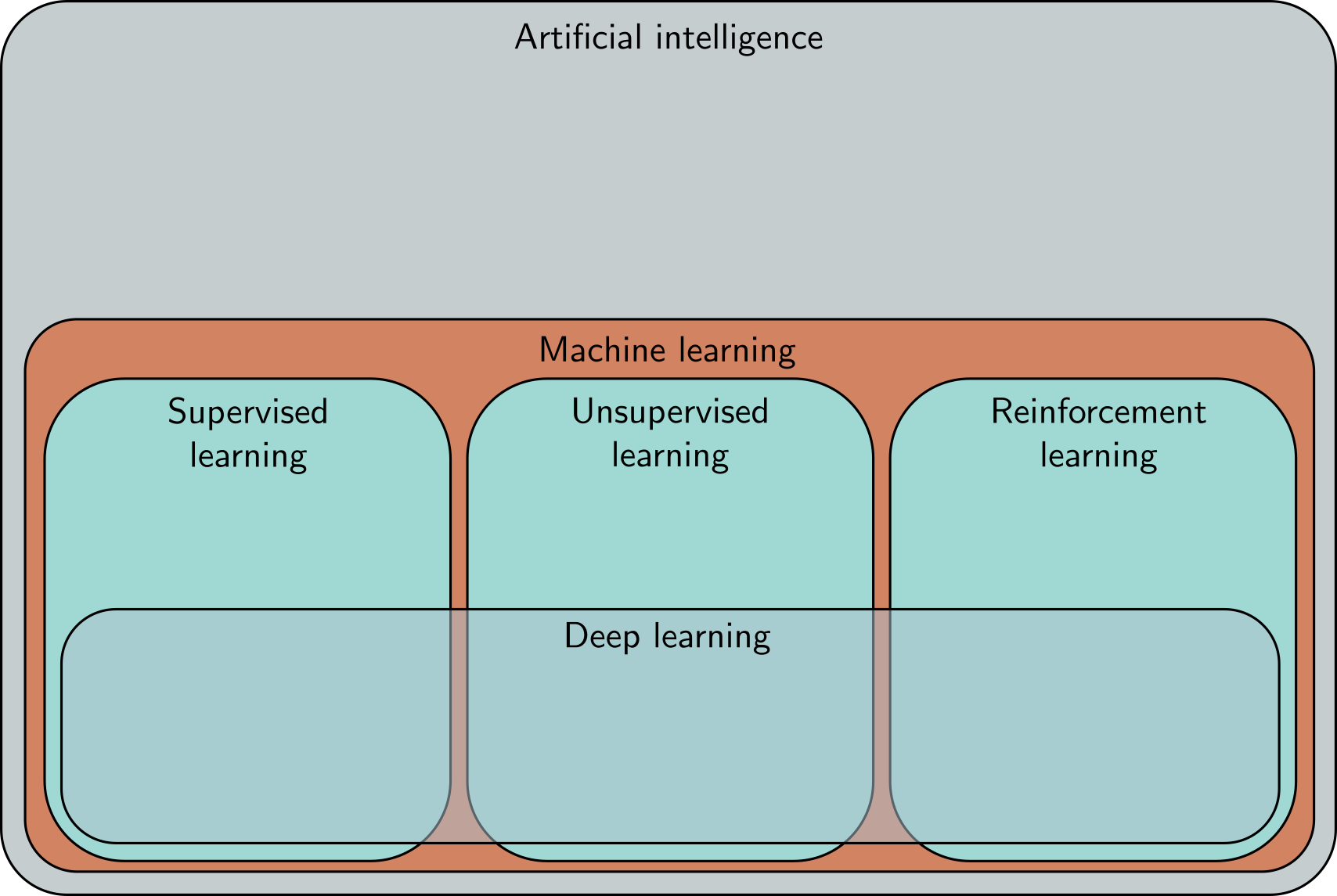
Landscape of AI
Figures from Understanding Deep Learning, by Simon J.D. Prince, used with permission
Debriefing sklearn notebook
Xis the independent variables,ythe dependent. (this terminology is more common in a statistics setting)- in ML, we call the columns of
Xthe features or predictors, andythe target. - The parallel lines of the linear regression are contours of the prediction, which is actually smooth (in fact, too smooth.)
- The descriptions of the plots are not clear. Notice how some of the boundaries are strictly horizontal/vertical while others are not. Notice how some boundaries are sharp while others are not.
- Why might the RF give lines like the tree, but less sharp lines? Answer: it’s the average of a bunch of trees, each of which has those sharp lines, but different ones.