Computing
What is Neural Computing
Key Questions
- How do neural nets compute? (How does that differ from traditional programming?)
- What are the “data structures” of neural computing and efficient operations we can do with them?
- How can we update parameters to optimize an objective function?
Learning Path
“I trained a neural net classifier from scratch.”
- Basic array/“tensor” operations in PyTorch
- Code: array operations
- Concepts: dot product, mean squared error
- Linear Regression “the hard way” (but black-box optimizer)
- Code: Representing data as arrays
- Concepts: loss function, forward pass, optimizer
- Logistic Regression “the hard way”
- Concepts: softmax, cross-entropy loss
- Multi-layer Perceptron
- Concepts: nonlinearity (ReLU), initialization
- Gradient Descent
- Concepts: backpropagation, training loop
- Data Loaders
- Concepts: batching, shuffling
Foundations
Jupyter Notebooks
- notebook = prose + code + output
- interfaces for notebooks: Jupyter (classic and Lab), VS Code, Kaggle, Google Colab (view-only: github, nbviewer)
- cell types
- Markdown (GitHub Docs, spec)
- Code
- Each code block feeds input to a hidden Python repl (“Shell” in Thonny)
- Possible to run code out of order
- Changing something doesn’t make dependent code re-run!
- Outputs: anything explicitly
display()ed orprint()ed orplot()ted—and the result of the last expression
- Each code block feeds input to a hidden Python repl (“Shell” in Thonny)
Model training and Evaluation
- Outline of notebooks
- Load the data
- Download the dataset.
- Set up the dataloaders (which handles train-validation split, batching, and resizing)
- Train a model
- Get a foundation model (an EfficentNet in our case)
- Fine-tune it.
- Get the model’s predictions on an image.
- Load the data
- Evaluating a model
- Accuracy: correct or incorrect?
- Loss:
- partial credit
- when it’s right, should be confident
- when it’s wrong, shouldn’t be confident
Markdown Tips
aka, things to make your work look more professional
- Headings: space between
#and the heading text - Multiple lines collapse to a single line unless you:
- Use a list (
- abc) - Add a blank space between
- manually add space (advanced technique)
- Use a list (
- Use backticks when you’re talking about
code(e.g., functions, variable names)
Random Seeds
- All four numbers will be different.
- The first two numbers will be the same, and the second two numbers will be the same.
- All four numbers will be the same.
0.9664535356921388
0.4407325991753527Logistic Regression
Code Example
# inputs:
# - x_train (num_samples, num_features)
# - y_train (num_samples, num_classes), one-hot encoded
num_classes = y_train.shape[1]
W = np.random.randn(num_features_in, num_classes)
b = np.random.randn(num_classes)

scores = x_train @ W + b
probs = softmax(scores, axis=1)

probs_of_correct = probs[np.arange(len(y_train)), y_train]
loss = -np.log(probs_of_correct).mean()
Check-in question: what loss function is this?
Where do the “right” scores come from?
- In linear regression we were given the right scores.
- In classification, we have to learn the scores from data.
A Story of A Classifier
Images as Input
- Each image is a 3D array of numbers (color channel, height, width) with rich structure: adjacent pixels are related, color channels are related, etc.
- Eventually we’ll handle this, but to simplify for now:
- Ignore color information: use grayscale images: 28x28 array of numbers from 0 to 255
- Ignore spatial relationships: flatten to 1D array of 784 numbers
Work through how this is done in the Chapter 2 notebook
Classification the Wrong Way
- Compute
y = x @ W + bto compute a one-dimensional outputyfor each image. - Compute the MSE loss between
yand the desired number (0-9). - Optimize the weights to minimize this loss.
Discuss with neighbors:
- Suppose you’re trying to classify an image of a 4. What might a prediction from this model look like? Compute the loss.
- What’s wrong with this approach? What might you do instead?
Fix 1: Multiple Outputs
We want a score for each digit (0-9), so we need 10 outputs.
Each output is 0 or 1 (“one-hot encoding”).
Discuss with neighbors:
- What’s the shape of the output?
- What must be the shape of the weights?
- What might an output from this model look like when given an image of a 4? What’s the loss?
Fix 2: Softmax (Large Values)
Suppose the network predicted 1.5 for the correct output.
Suppose instead the network predicted 0.5 for the correct output.
What’s the loss in each case?
Fix: make outputs be probabilities.
- Exponentiate each output
- Divide by the sum of all exponentiated outputs
Discuss with neighbors:
- What might an output from this model look like? What’s the loss for your running example?
Fix 3: Cross-Entropy Loss
Negative log of the probability of the correct class.
Compute the loss for your running example.
The Data Structures of Neural Computing
- Array / Tensor: the basic data structure
- We’ve used them in a few different ways
- Inputs to the model
- sometimes each entry is meaningful (e.g., characteristics of a home, vitals of a patient)
- sometimes entries only meaningful in aggregate (e.g., pixels in an image)
- Outputs of the model (predictions, targets)
- Parameters of the model (weights, biases)
- Intermediate computations (e.g., logits, gradients)
- Embedding: what we’ll talk about today
- Inputs to the model
Defining Embeddings
Embedding noun: a vector representation of an object, constructed to be useful for some task (not necessarily human-interpretable); verb: to construct such a representation.
Similar items get similar embeddings.
Similarity can be defined as:
- Euclidean distance
- Dot product
- Cosine similarity
(Note: some sources describe “embedding” as a specific lookup operation, but we’ll use it more broadly.)
Example: Word Embeddings
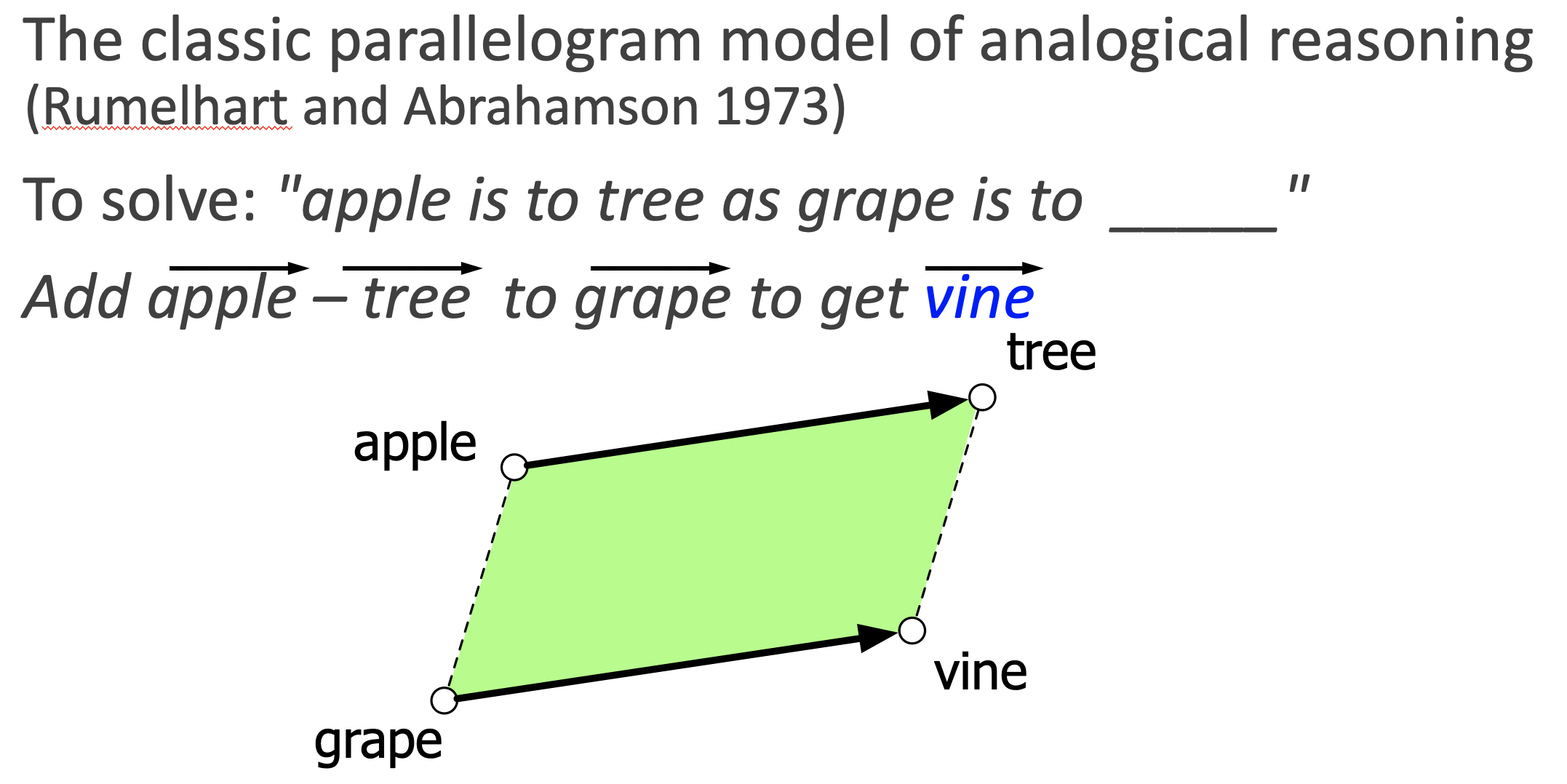
Source: Jurafsky and Martin. Speech and Language Processing 3rd ed
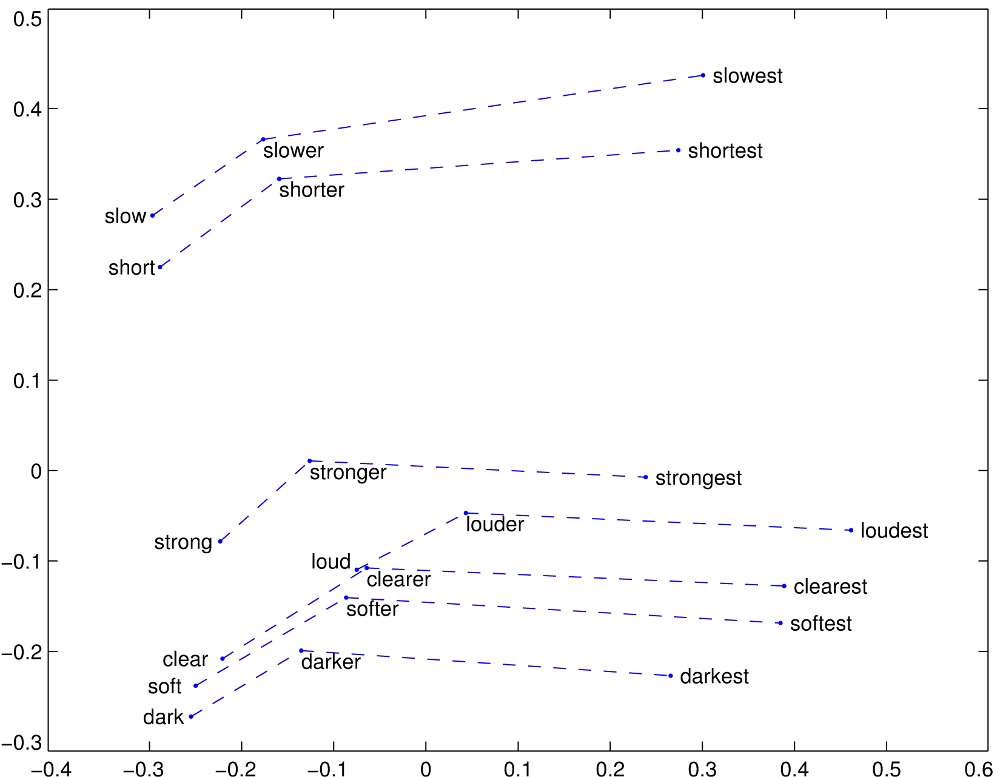
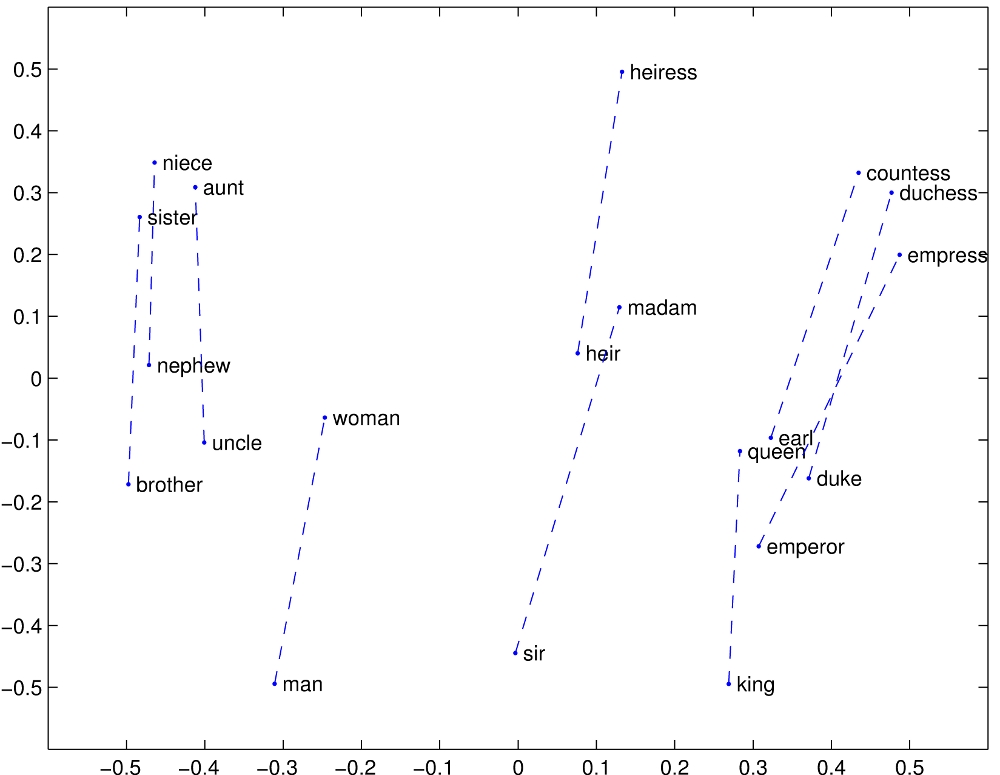
See also: Word embeddings quantify 100 years of gender and ethnic stereotypes (Garg et al, PNAS 2018)
Source: GloVe project
Example: Movie Recommendations
- Each movie gets an embedding vector (analogy: genres)
- Each user gets an embedding vector (analogy: genre preferences)
- Predict rating as dot product of user and movie vectors
Similar people end up with similar vectors because they like similar movies.