I think that [Judea’s work] is
going to change the world. –
Stuart Russell, Judea Pearl Symposium, 2010
In these lab exercises, you work with Bayesian networks.
Bayes Networks Review
This exercise reviews the burglary example from the text (Figure
14.2).
Exercise 6.1
Do the following exercises based on AIMA’s burglary
example given in Figure 14.2.
Download the following sample code: lab1.py.
Verify that the code produces the correct answers for
the following examples from the text and lecture:
- P(Alarm | burglary ∧ ¬earthquake)
- P(John | burglary ∧ ¬earthquake)
- P(Burglary | alarm)
- P(Burglary | john ∧ mary)
Be sure that you can explain these answers (i.e., by
reviewing your class notes or the text, Section 14.4.1).
Conditional Independence
The following exercises demonstrate conditional independence using
Bayesian networks that have varied topologies. See Section 13.5.2 for
a discussion of conditional independence. The first exercise concerns
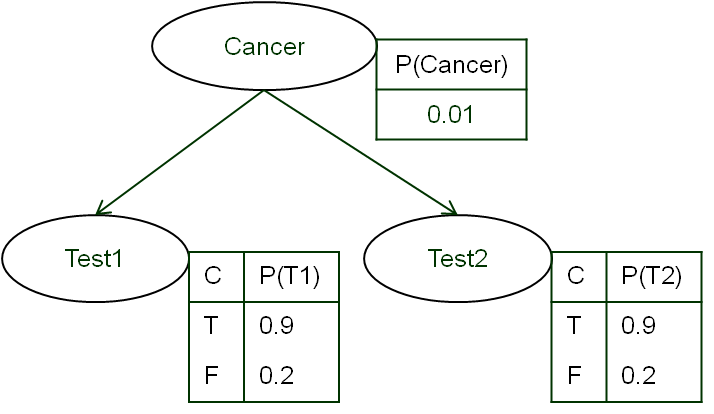
a two-test cancer example.1
Exercise 6.2
| The Bayesian network shown on the right represents a cancer
domain in which two different cancer tests can be run and in which
the tests are considered to be conditionally independent of one
another.
Implement this network and use it to compute the following
probabilities:
- P(Cancer | positive results on both
tests)
- P(Cancer | a positive result on test 1,
but a negative result on test 2)
Do the results make sense? How much effect does one failed
test have on the probability of having cancer?
Be sure that you can explain your answers (i.e., by working
them out by hand).
|
 |
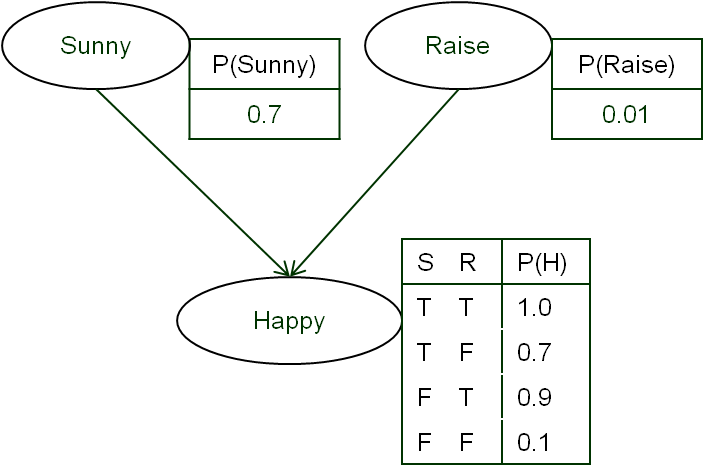
The second example concerns a two-cause happiness example.2
Here, the causes are conditionally independent as well, but their
probabilities can influence one another during inference.
Exercise 6.3
|
The Bayesian network shown on the right represents a
happiness domain in which either the sun or a raise in pay can
increase the happiness of an agent.
Implement this network shown and use it to compute
the following probabilities:
- P(Raise | sunny)
- P(Raise | happy ∧ sunny)
Be sure that you can explain these answers by hand. Use your implementation to compute the following
probabilities:
- P(Raise | happy)
- P(Raise | happy ∧ ¬sunny)
Do these results make sense to you? Why or why not? We
leave working these problems out by hand as an exercise for
later.
|
 |
Approximate Inference Algorithms for Bayesian Networks
The exact inference algorithms used above tend to be intractable
in real problems, so approximation algorithms are necessary.
Exercise 6.4
Rerun your the inferences specified in the previous exercises
using rejection sampling (see Figure 14.14), likelihood estimate (see
Figure 14.15), and Gibbs sampling (see Figure 14.16). Do the results
match those of the exact inference algorithms? Why or why not?
Checking in
Submit your source code as specified above in Moodle under lab 6.
1 This example is taken from Thrun’s two-test cancer
example.
2 This example is taken from Thrun’s
confounding clause example.
Back to the top