class: center, middle, inverse, title-slide # Welcome to CS 344 ## AI / Machine Learning<br>Spring 2021 ### Ken Arnold ### 2021-02-03 --- ## Pandemic Protocol The virus has upped its game. So we need to do likewise. 1. Please show your green Campus Clear as you walk in. 2. Please record where you're sitting on the [attendance sheet](https://docs.google.com/spreadsheets/d/1FCogt4a5yv3_jauwA6EUkzCYrVV0Yww6OoLplM7Tq54/edit#gid=112619962): * <http://tiny.cc/cs344here> * or link on Moodle. --- ## God *expects* intelligence * In what way does this text expect *us* to perceive / think / act intelligently? * In what way does this text show us how *God* perceives / thinks / acts intelligently? [**Psalm 103** NIV](https://www.biblegateway.com/passage/?search=psalm+103&version=NIV) Praise the Lord, my soul; all my inmost being, praise his holy name. Praise the Lord, my soul, and forget not all his benefits— who forgives all your sins and heals all your diseases, who redeems your life from the pit and crowns you with love and compassion, who satisfies your desires with good things so that your youth is renewed like the eagle’s. The Lord works righteousness and justice for all the oppressed. He made known his ways to Moses, his deeds to the people of Israel: The Lord is compassionate and gracious, slow to anger, abounding in love. He will not always accuse, nor will he harbor his anger forever; he does not treat us as our sins deserve or repay us according to our iniquities. For as high as the heavens are above the earth, so great is his love for those who fear him; as far as the east is from the west, so far has he removed our transgressions from us. ??? **w2**: We are to remember: call to mind, recall past episodes of his work for us, individually and jointly, in our own experience or in history. We are to consider what implications these past episodes have for our present situation. And we are to think not just of episodes (like the Exodus) but also of the promises and statements about God (like the giving of the Law and the promises of blessing). **v6**: Now we learn some more specifics about God’s intelligence. He “works righteousness and justice”. That is, he uses eternal and grand standards of what the right actions and outcomes are, and applies them to a specific circumstance of each specific person. Furthermore, he identifies that certain people are oppressed—he must observe and evaluate the relationships of authority and vulnerability between people. To understand this, we must act intelligently—we must recall what God did in and through Moses, understood not through direct experience but through reading and hearing the various accounts of these events. We must be able to understand what it means for a person to be “merciful” and “gracious”—descriptions of someone’s character and general pattern of behavior, abstracted from individual incidents. The concepts of mercy and grace themselves require us to understand moral requirements, evaluate ourselves in light of them (to know that we need mercy and grace), and recognize our state of affairs with God as the result of God being “merciful and gracious”. --- ## Minimal Logistics Before Friday class: * Skim the Syllabus * Sign up for Piazza * Optional Python review quiz * Come to Maroon lab on Friday (overflow to Gold) Before Monday class: * Get *Deep Learning for Coders* (or read the notebook version) and read chapter 1 * Watch <https://course.fast.ai/videos/?lesson=1> * Complete the reading quiz on Moodle --- .center[ ## Let's do some machine learning! ] Pick a partner. Decide who will be the *trainer* and who's the *tester*. **Trainer**: * Go to <https://teachablemachine.withgoogle.com/train/image> * Train a simple classifier using your webcam. * Ideas: use your hands, your face, objects you have on you, ... * Don't worry about making it super accurate. **Tester**: * Try out your partner's classifier (without touching the computer or the same objects). * Try to find some situations where it works * Try to find the most amusing situation where it fails. <div class="countdown blink-colon noupdate-15" id="timer_6027e2dc" style="right:0;bottom:0;" data-warnwhen="0"> <code class="countdown-time"><span class="countdown-digits minutes">15</span><span class="countdown-digits colon">:</span><span class="countdown-digits seconds">00</span></code> </div> --- ## What is this course? This is a course on developing AI systems using machine learning, with a particular emphasis on deep neural networks. ### Objectives By the end of this course, you will demonstrate growth in your ability to: - *Design, implement,* and *analyze* some state-of-the-art types of data-fueled intelligent systems - *Design* and *analyze* how these intelligent systems relate with people, individually and collectively, through a Reformed Christian lens. - Communicate the above with peers and members of the general public - Contribute to a team that learns: identify what you need to learn, reflect on your own learning, and help others learn --- ## Real objective .center[ **You graduate and do amazing work in AI.** ] So, you should be: * self-directed, collaborative learners * able to be immediately productive at some kinds of ML problems * in the habit of practicing the integrity and perseverance needed to work in a team --- ## Approach * *Very* hands-on * "Flipped": read and watch lectures at home, hack together in class * Watching and/or reading is expected. Make time for it. --- ## Materials .pull-left[ 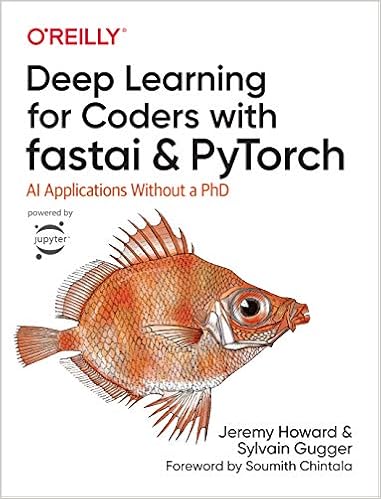 ] .pull-right[ Why the [fastai course](https://course.fast.ai/)? * Author Jeremy Howard (author and video lecturer) has extensive experience * Past students of the fastai course have published original research and won competitions * Custom [software library](https://docs.fast.ai/) builds on PyTorch * a close competitor to TensorFlow * popular in academic research * [layered API](https://www.mdpi.com/2078-2489/11/2/108/htm) speeds up development * Jupyter Notebooks: you can run everything yourself ] --- ## Why not just learn this on your own? This course gives you: * Structure * An instructor * Peers * Freedom to ask stupid questions --- ## Structure We will vary our pace depending on students' needs, but the structure will be predictable: * **Weekend**: read (actively!) a textbook chapter, watch a video lecture * **Monday Lab**: apply what you've just read, extend it slightly * **Tuesday**: write your weekly learning reflection, contribute to discussion forums * **Wednesday Discussion** (in classroom): debrief lab, discuss perspectives * **Thursday**: take a content quiz (most weeks, not this week) * **Friday Lab**: work on homework / project; micro-lectures as needed --- ## Who am I? * Husband, father of two 3-year-old girls * Natural Language Processing + Human-Computer Interaction --- ## Peers Your peers provide: * **Collaborators**. You'll be able to do great projects together. * **Learning community**. I may be one of your last official teachers. But you most keep learning. * **Discussion partners**. Your peers bring valuable perspectives. * **Practice analyzing other people's work**. It will be most of what you do. So we must practice it. We will do some peer feedback during our time together. --- ## "I don't know" * Say this often. * I will too. * Ask questions on Piazza. * When you've figured it out, communicate (e.g., a blog) --- ## Ungrading. Any work that can be graded consistently, fairly, and efficiently can be automated. We must focus on skills that cannot be automated. Most important: *meta*cognition: awareness of what you know and don't. We practice this by active reflection on your learning. Evidence is super-clear: intrinsic motivation is awesome, curiosity and creativity are core to what make us human, and grading kills intrinsic motivation and curiosity. How? You'll suggest your own grades for your *learning* (not your *work*) each *week*, and finally an overall written self-reflection. See syllabus for details. --- ## Testers needed Need 1 or 2 people to stay after class (or Teams later) to test our remote lab setup.