Computing
What is Neural Computing
Key Questions
- How do neural nets compute? (How does that differ from traditional programming?)
- What are the “data structures” of neural computing and efficient operations we can do with them?
- How can we update parameters to optimize an objective function?
Learning Path
“I trained a neural net classifier from scratch.”
- Basic array/“tensor” operations in PyTorch
- Code: array operations
- Concepts: dot product, mean squared error
- Linear Regression “the hard way” (but black-box optimizer)
- Code: Representing data as arrays
- Concepts: loss function, forward pass, optimizer
- Logistic Regression “the hard way”
- Concepts: softmax, cross-entropy loss
- Multi-layer Perceptron
- Concepts: nonlinearity (ReLU), initialization
- Gradient Descent
- Concepts: backpropagation, training loop
- Data Loaders
- Concepts: batching, shuffling
Foundations
Lab 1 Review
Open up your Lab 1 notebooks. Discuss with your neighbors:
- What’s the rule for what outputs you see from a code chunk?
- What parameter changes did you try in the image classifier? What did you observe?
- What else did you learn? Is there anything you’d like us to go over together?
Lab Takeaways
- How lab notebooks work
- self-contained
- Tasks (marked with “Task”)
- blank code cells (labeled
# your code here)
- emphasize process over product
- check-in quizzes on Moodle
- self-contained
- getting set up on Kaggle
Jupyter Notebooks
- notebook = prose + code + output
- interfaces for notebooks: Jupyter (classic and Lab), VS Code, Kaggle, Google Colab (view-only: github, nbviewer)
- cell types
- Markdown (GitHub Docs, spec)
- Code
- Each code block feeds input to a hidden Python repl (“Shell” in Thonny)
- Possible to run code out of order
- Changing something doesn’t make dependent code re-run!
- Outputs: anything explicitly
display()ed orprint()ed orplot()ted—and the result of the last expression
- Each code block feeds input to a hidden Python repl (“Shell” in Thonny)
Model training and Evaluation
- Outline of notebooks
- Load the data
- Download the dataset.
- Set up the dataloaders (which handles train-validation split, batching, and resizing)
- Train a model
- Get a foundation model (an EfficentNet in our case)
- Fine-tune it.
- Get the model’s predictions on an image.
- Load the data
- Evaluating a model
- Accuracy: correct or incorrect?
- Loss:
- partial credit
- when it’s right, should be confident
- when it’s wrong, shouldn’t be confident
Markdown Tips
aka, things to make your work look more professional
- Headings: space between
#and the heading text - Multiple lines collapse to a single line unless you:
- Use a list (
- abc) - Add a blank space between
- manually add space (advanced technique)
- Use a list (
- Use backticks when you’re talking about
code(e.g., functions, variable names)
Random Seeds
- All four numbers will be different.
- The first two numbers will be the same, and the second two numbers will be the same.
- All four numbers will be the same.
0.9664535356921388
0.4407325991753527Array Programming: numpy
aka np, because it’s canonically imported as:
numpy
- Numerical computing library for Python
- Provides the
arraydata type. Like alistbut:- Automatic
forloops! - Supports multiple dimensions
- Automatic
- …and lots of utilities
arange:rangethat makesarrayszeros/ones/full: make new arrays- lots of math functions
example
Arrays have consistent data types
All ints:
All floats:
np.arange
Like range, but:
- makes NumPy
arrays - allows
floats
Broadcasting (automatic for loops!)
array plus scalar:
array plus array:
Applying a function to every element:
Reduction operations
Reduce the dimensionsionality of an array (e.g., summing over an axis)
Exercise: computing error
Suppose the true values are:
and two model predictions are:
- In what sense is Model A better? In what sense is Model B better? Try to quantify the score of each model in at least 2 different ways.
- Write NumPy expressions to compute each of the errors you listed.
Quantifying Error
Error Metrics
MAE: mean absolute error: average of absolute differences
\[ \text{MAE} = \frac{1}{n} \sum_{i=1}^n |y_i - \hat{y}_i| \]
Contrasting MAE and MSE
- Which model had a better MAE? Which had a better MSE?
- What do you notice about the specific mistakes that the models made?
Linear Regression
Model = architecture + loss + data + optimization
From Linear Regression to Neural Networks
CS 375:
- Nonlinear transformations (ReLU, etc.)
- Extend to classification (softmax, cross-entropy loss)
- More layers (“deep learning”)
CS 376:
- Handle structure (locality of pixels in images, etc.)
- Flexible data flow (attention, recurrences, etc.)
Linear Regression with One Output
# inputs:
# - x_train (num_samples, num_features)
# - y_train (num_samples)
num_features_in = x_train.shape[1]
w = np.random.randn(num_features_in)
b = np.random.randn()

y_pred = x_train @ w + b
loss = ((y_train - y_pred) ** 2).mean()
Check-in question: what loss function is this?
Multiple Inputs and Outputs
y = x1*w1 + x2*w2 + x3*w3 + b- Or:
y = x @ W + b
Matmul (@) so we can process every example of x at once:
xis 100 samples, each with 3 features (x.shapeis(100, 3))Wgives 4 outputs for each feature (W.shapeis(3, 4))- Then
x @ Wgives 100 samples, each with 4 outputs ((100, 4)) - Think: what is
b’s shape?
Linear Regression with Multiple Outputs
# inputs:
# - x_train (num_samples, num_features_in)
# - y_train (num_samples, num_features_out)
num_features_out = y_train.shape[1]
W = np.random.randn(num_features_in, num_features_out)
b = np.random.randn(num_features_out)

y_pred = x_train @ W + b
loss = ((y_train - y_pred) ** 2).mean()Wis now a 2-axis array: how much each input contributes to each outputbis now a 1-axis array: a number to add to each output
Logistic Regression
Code Example
# inputs:
# - x_train (num_samples, num_features)
# - y_train (num_samples, num_classes), one-hot encoded
num_classes = y_train.shape[1]
W = np.random.randn(num_features_in, num_classes)
b = np.random.randn(num_classes)

scores = x_train @ W + b
probs = softmax(scores, axis=1)

probs_of_correct = probs[np.arange(len(y_train)), y_train]
loss = -np.log(probs_of_correct).mean()
Check-in question: what loss function is this?
Intuition: Elo
A measure of relative skill:
- Higher Elo more likely to win
- Greater point spread -> more confidence in win
Formal definition:
Pr(A wins) = 1 / (1 + 10^(-EloDiff / 400))
EloDiff = A Elo - B Elo
- Uses: chess, NFL
- 538’s Superbowl prediction (discussion)
- sometimes adjusted, e.g., for playoffs, 538 multiplies EloDiff by 1.2 (wider margins in playoffs)
From scores to probabilities
Suppose we have 3 chess players:
| player | Elo |
|---|---|
| A | 1000 |
| B | 2200 |
| C | 1010 |
A and B play. Who wins?
A and C play. Who wins?
Softmax
See nfelo
- Pick a pair of teams from the list.
- Compute the difference in their Elo ratings.
- Compute the probability that the higher-rated team wins.
- Repeat for another pair of teams.
Elo probability formula:
Pr(A wins) = 1 / (1 + 10^(-EloDiff / 400))
Softmax
- Start with scores (use variable name
logits), which can be any numbers (positive, negative, whatever) - Make them only positive by exponentiating:
xx = exp(logits)(logits.exp()in PyTorch)- alternatives:
10 ** logitsor2 ** logits
- Make them sum to 1:
probs = xx / xx.sum()
Some properties of softmax
- Sums to 1 (by construction)
- Largest logit in gets biggest prob output
logits + constantdoesn’t change output.logits * constantdoes change output.
Sigmoid
Special case of softmax when you just have one score (binary classification): use logits = [score, 0.0]
Exercise for practice: write this out in math and see if you can get it to simplify to the traditional way that the sigmoid function is written.
Where do the “right” scores come from?
- In linear regression we were given the right scores.
- In classification, we have to learn the scores from data.
Nonlinear Features
ReLU
Chop off the negative part of its input.
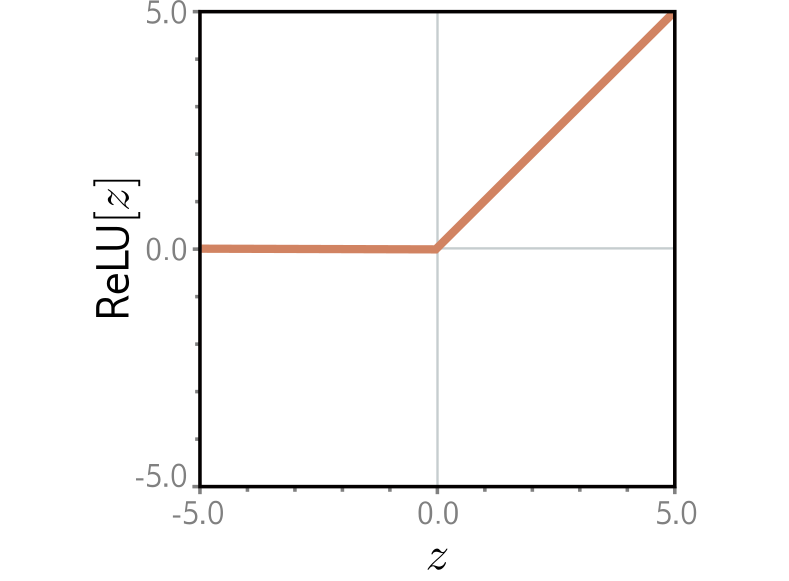
y = max(0, x)
(Gradient is 1 for positive inputs, 0 for negative inputs)
Why is ReLU Useful?
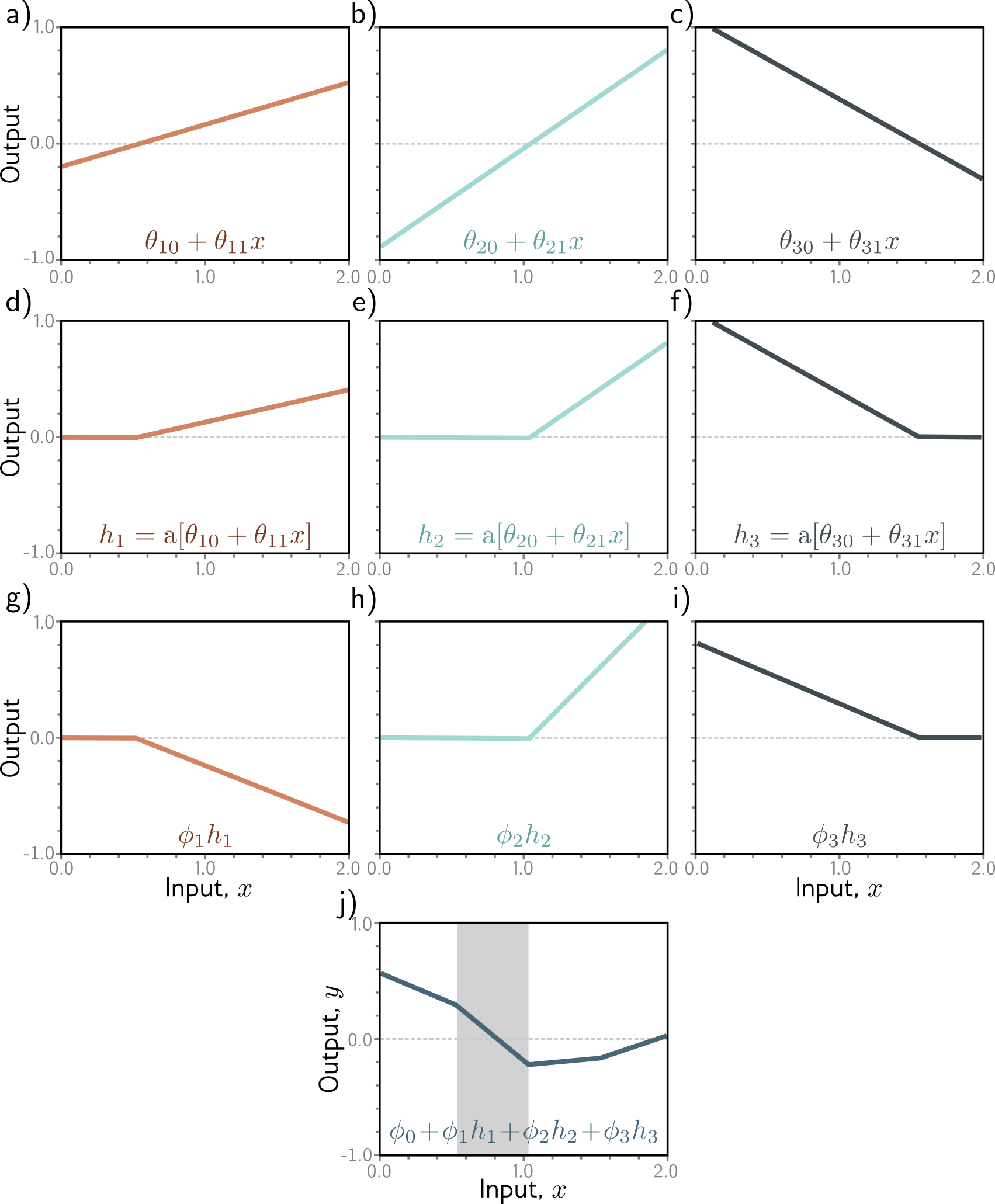
In 2D
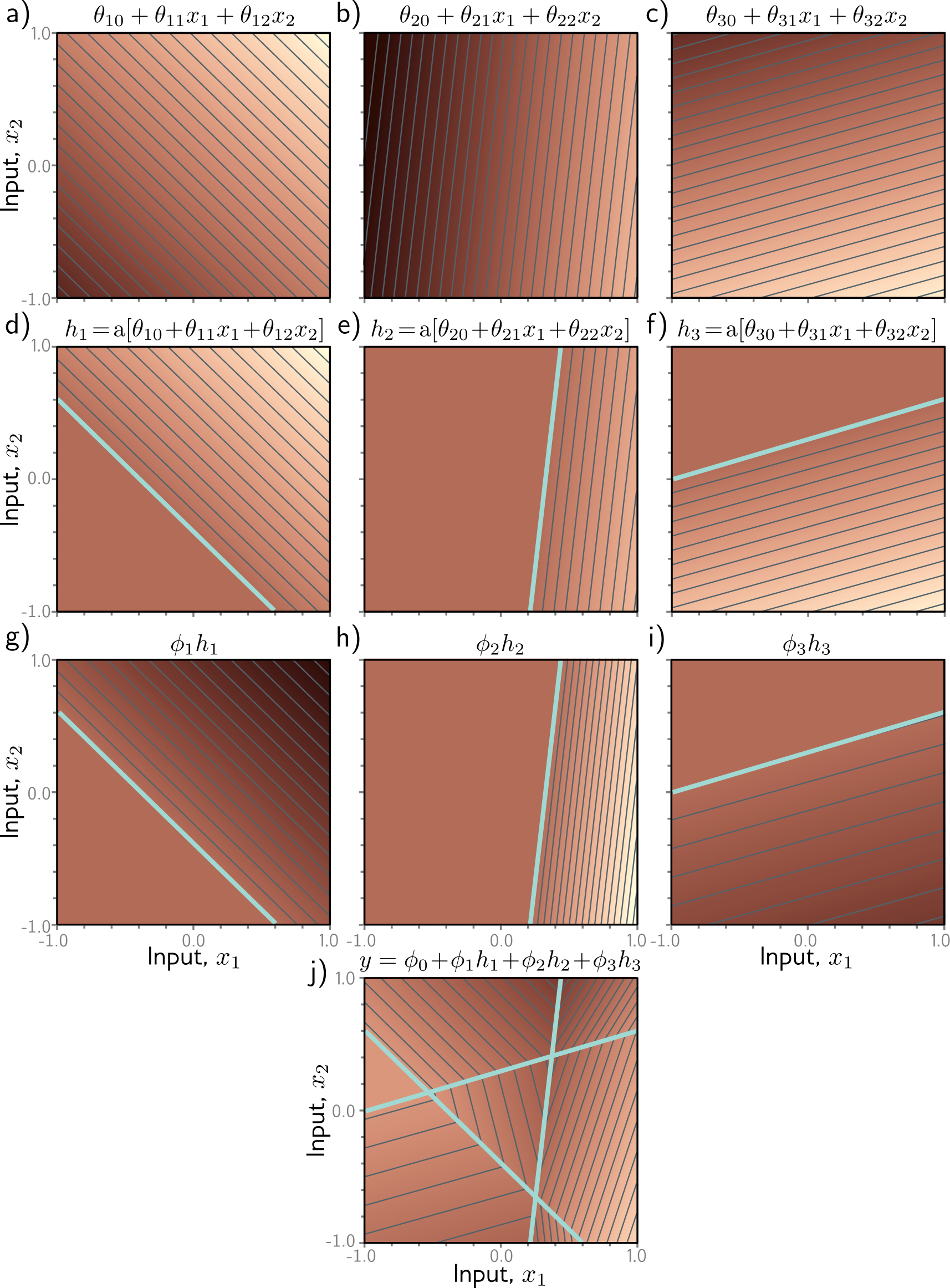
Interactive Activity
ReLU interactive (name: u04n00-relu.ipynb; show preview, open in Colab)
Gradient Descent
(Stochastic) Gradient Descent algorithm
- Get some data
- Forward pass: compute model’s predictions
- Loss computation: compare predictions to targets
- Backward pass: compute gradient of loss with respect to model parameters
- Update: adjust model parameters in a direction that reduces loss (“optimization”)
- Gradient descent: do this on the whole dataset
- Stochastic Gradient Descent (SGD): do this on subsets (mini-batches) of the dataset
What it looks like in different libraries
PyTorch
TensorFlow (low-level)
import tensorflow as tf
import keras

model = keras.layers.Dense(1, input_shape=(3,))
loss_fn = keras.losses.MeanSquaredError()
optimizer = keras.optimizers.SGD()
# ...
with tf.GradientTape() as tape:
    y_pred = model(x)
    loss = loss_fn(y, y_pred)
grads = tape.gradient(loss, model.trainable_weights)
optimizer.apply_gradients(zip(grads, model.trainable_weights))
Automatic Differentiation
- Programmer computes the forward pass
- Library computes the backward pass (gradients) using the backpropagation algorithm
- Start at the end (loss)
- Work backwards through the computation graph
- Use the chain rule to compute gradients
Upshot: we can differentiate programs.
A Story of A Classifier
Images as Input
- Each image is a 3D array of numbers (color channel, height, width) with rich structure: adjacent pixels are related, color channels are related, etc.
- Eventually we’ll handle this, but to simplify for now:
- Ignore color information: use grayscale images: 28x28 array of numbers from 0 to 255
- Ignore spatial relationships: flatten to 1D array of 784 numbers
Work through how this is done in the Chapter 2 notebook
Classification the Wrong Way
- Compute
y = x @ W + bto compute a one-dimensional outputyfor each image. - Compute the MSE loss between
yand the desired number (0-9). - Optimize the weights to minimize this loss.
Discuss with neighbors:
- Suppose you’re trying to classify an image of a 4. What might a prediction from this model look like? Compute the loss.
- What’s wrong with this approach? What might you do instead?
Fix 1: Multiple Outputs
We want a score for each digit (0-9), so we need 10 outputs.
Each output is 0 or 1 (“one-hot encoding”).
Discuss with neighbors:
- What’s the shape of the output?
- What must be the shape of the weights?
- What might an output from this model look like when given an image of a 4? What’s the loss?
Fix 2: Softmax (Large Values)
Suppose the network predicted 1.5 for the correct output.
Suppose instead the network predicted 0.5 for the correct output.
What’s the loss in each case?
Fix: make outputs be probabilities.
- Exponentiate each output
- Divide by the sum of all exponentiated outputs
Discuss with neighbors:
- What might an output from this model look like? What’s the loss for your running example?
Fix 3: Cross-Entropy Loss
Negative log of the probability of the correct class.
Compute the loss for your running example.
Embeddings
The internal data structure of neural networks.
General Neural Network Architecture
- Initial layers extract features from input
- Final layers make decisions based on those features
flowchart LR
    A[Input] --> B[Feature Extractor]
    B --> C[Linear Classifier]
    C --> D[Output]
Example:
flowchart LR
    A[Input] --> B["Pre-trained CNN"]
    B --> C["Linear layer with 3 outputs"]
    C --> D["Softmax"]
    D --> E["Predicted probabilities"]
    style B stroke-width:4px
Your Homework 1 Architecture
- The Feature Extractor is composed of:
- a convolutional neural network …
- pre-trained on some classification task …
- with the linear classifier removed
- Linear Classifier: a linear layer plus a softmax (like we’ve been using)
The feature extractor constructs a representation of the input that’s useful for classification.
- A linear classifier on the raw pixels couldn’t learn much.
- A linear classifier on the features extracted by a CNN can learn a lot.
- The CNN computes an embedding of the input image.
The Data Structures of Neural Computing
- Array / Tensor: the basic data structure
- We’ve used them in a few different ways
- Inputs to the model
- sometimes each entry is meaningful (e.g., characteristics of a home, vitals of a patient)
- sometimes entries only meaningful in aggregate (e.g., pixels in an image)
- Outputs of the model (predictions, targets)
- Parameters of the model (weights, biases)
- Intermediate computations (e.g., logits, gradients)
- Embedding: what we’ll talk about today
- Inputs to the model
Defining Embeddings
Embedding noun: a vector representation of an object, constructed to be useful for some task (not necessarily human-interpretable); verb: to construct such a representation.
Similar items get similar embeddings.
Similarity can be defined as:
- Euclidean distance
- Dot product
- Cosine similarity
(Note: some sources describe “embedding” as a specific lookup operation, but we’ll use it more broadly.)
Example: Word Embeddings
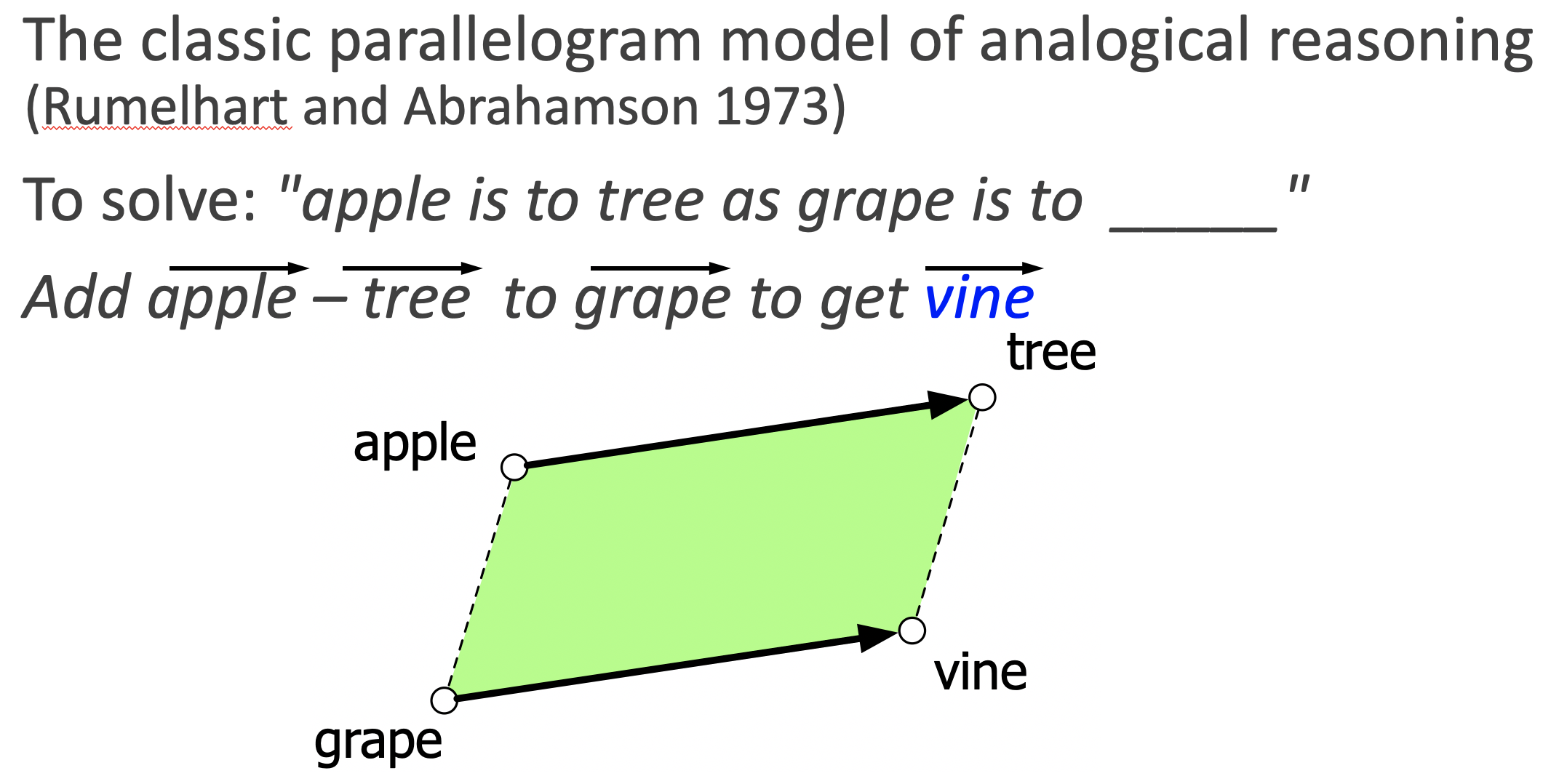
Source: Jurafsky and Martin. Speech and Language Processing 3rd ed
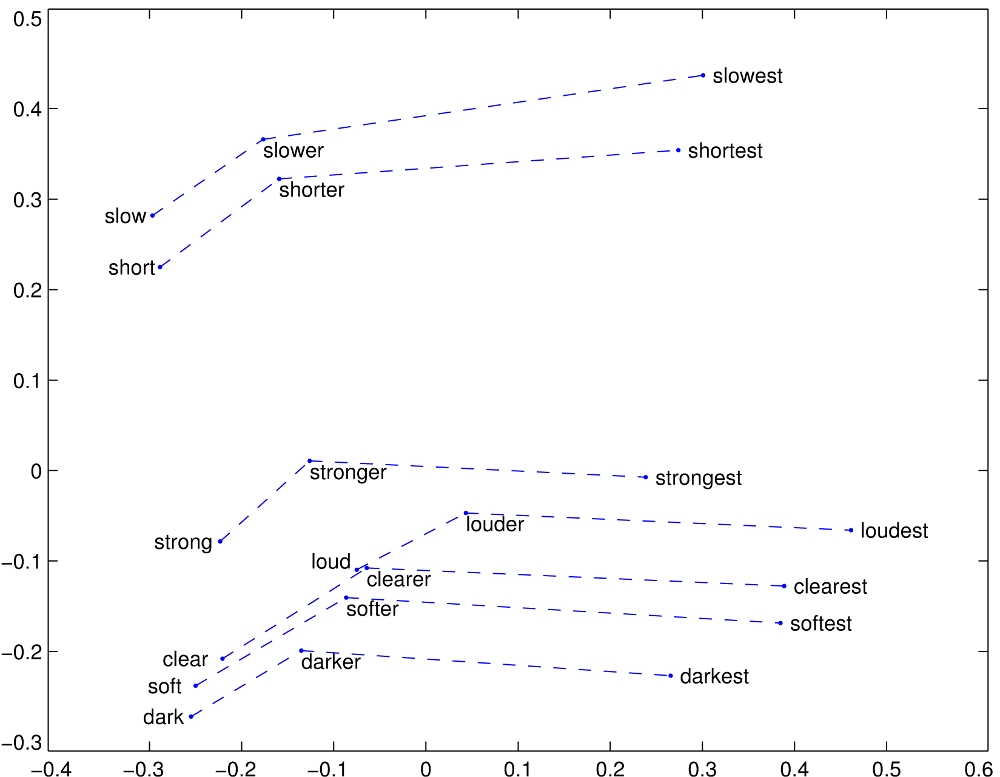
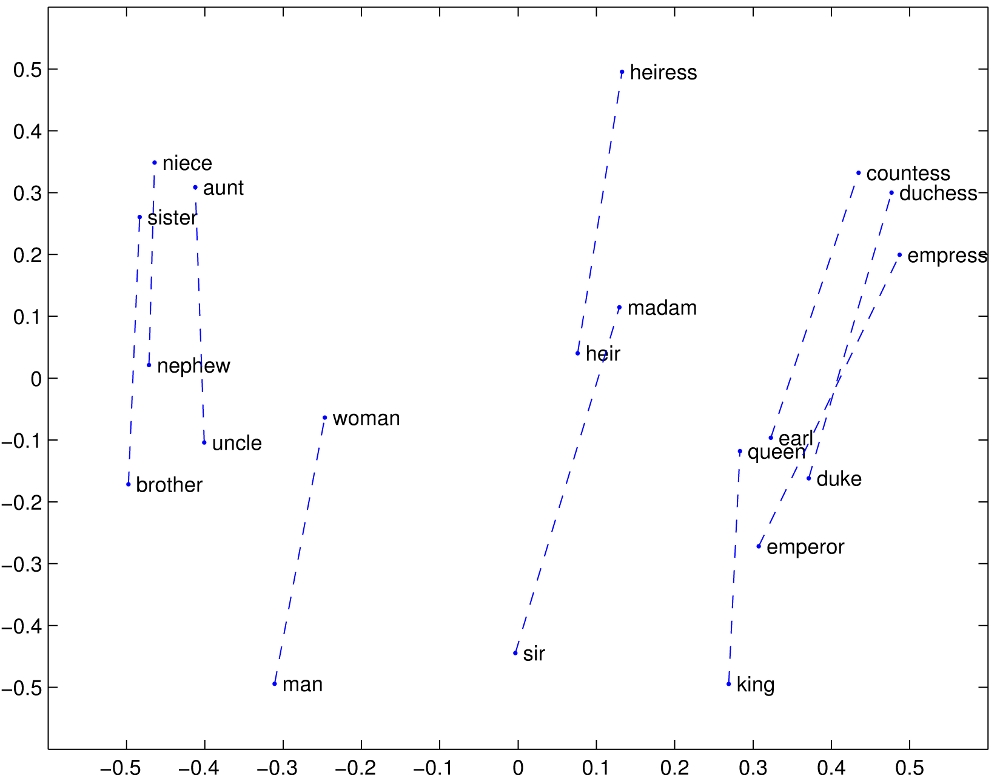
See also: Word embeddings quantify 100 years of gender and ethnic stereotypes (Garg et al, PNAS 2018)
Source: GloVe project
Example: Movie Recommendations
- Each movie gets an embedding vector (analogy: genres)
- Each user gets an embedding vector (analogy: genre preferences)
- Predict rating as dot product of user and movie vectors
Similar people end up with similar vectors because they like similar movies.